Craig and Sal Go Global
Volunteering on the border: An A to Z
February 12, 2013
So much has happened in the four weeks that we’ve been volunteering, that it’s hard to even know where to start. So rather than try to say everything, we thought we’d write an A to Z with a taster of some of the things we’ve experienced and learnt while we’ve been here.
A is for the amazing students at the college. They are so generous, grateful and eager to learn. Despite what they have been through, they are so cheerful and full of energy.
B is for all the bemusing moments that teaching at a school in rural Thailand brings. Like goats and chickens wandering across the back of the classroom during a test.
C is for cross-cultural differences. Both of us have a structured and planned approach to work, so we’re having to learn to march to a different beat here. Our new mantra is: “go with the flow and don’t assume it will happen until it happens”. Cultural differences in power distance, problem solving, leadership and communication have all been interesting learning experiences.
D is for the school dog Waiki. He likes to get amongst the action, even making himself at home on-stage during dance and drama performances.
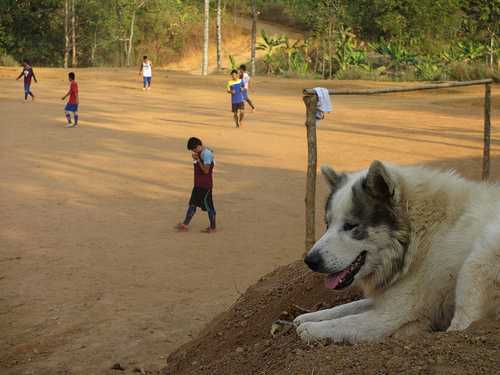
E is for early-risers. The Karen tend to wake up early and morning study time begins at 6:00am. But, as if that weren’t early enough, some of the students go for a run first at 5:30am. It’s hard to sleep past sunrise thanks to the many diligent roosters calling in the new day.
The Buddhist monastery in the village often blasts out music and sermons from loudspeakers. This isn’t our favourite cultural experience, given that it sometimes starts up at 5:00am on a Saturday morning!
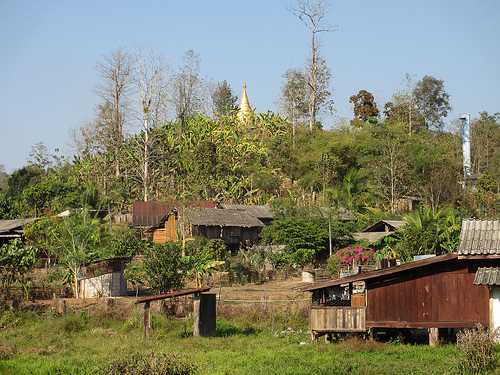
F is for fear. Fear of returning to a more ordinary life that is. We are in a beautiful, remote setting, at a school that is helping to educate young Karen at a critical time in the history of their people. How are we going to cope with going back to a routine existence!?
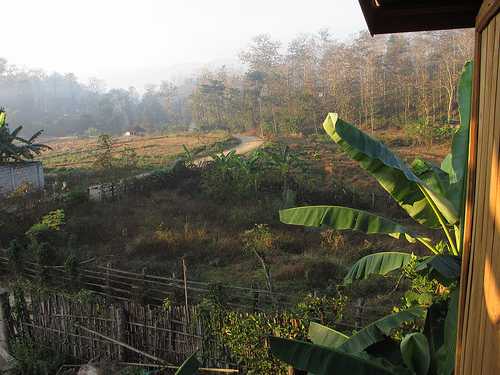 The view from our bedroom window
G is for the many games that are played after school. The students are all active and fit – each day there is volleyball, badminton, basketball and a spectacular game called caneball. We’ve also been trying to introduce Frisbee to daily “play time”.
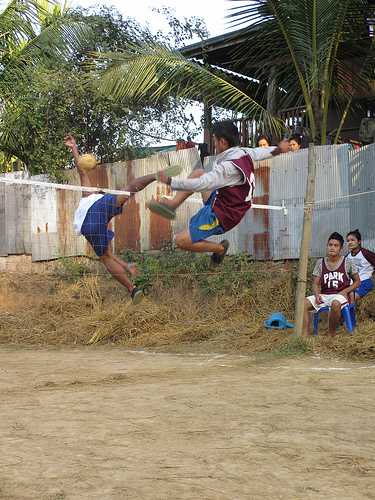 Caneball
H is for the many holidays that are celebrated here. Already we have been “over the river” into Burma to celebrate two Karen holidays – Karen New Year and Karen Revolution Day.
I is for the internet. The students here are lucky to have access to the internet via a satellite dish. In Burma, internet access is rarely available, and until recently it was heavily censored. It is great to be able to expose the students to international news and ideas so easily.
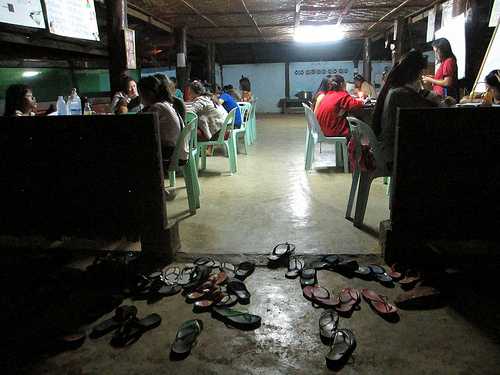
J is for jandals. As with many Asian cultures, Karen people remove their shoes before going inside, to keep the floors clean. Looking for someone? You just have to find which doorway their jandals are sitting at!
K is for the Karen people. The Karen are an ethnic group of around 7-10 million people. They live throughout Burma, with most living in Karen State (east of Yangon, bordering Thailand). The Karen are the largest ethnic minority in Myanmar, making up just under 10% of the population.
L is for lesson planning. It is occupying an awful lot of our time and thoughts right now! I guess learning how to be ESOL, social studies, geography and life skills teachers in a few weeks was never going to be easy!
M is for all of the funny misunderstandings of ESOL teaching. Like helping a student by explaining the definition of “hero” only to have them confusedly point out a heron in an encyclopaedia. Or expressing our deepest condolences to a student whose dad had “passed” last year, only to later find out that her dad had passed his exam at a nearby college!
N is for nationhood. Something we take for granted, but many people on this border are not recognised as citizens of any nation. Most of the students came from Mae La, a nearby refugee camp which houses 50-70,000 people. The camps on the border house people who have fled Burma after the army burnt their villages to the ground. They cannot safely return to Burma and are not allowed to work in Thailand. To leave the camp they must have a signed permission letter, which is checked at the numerous checkpoints on the border road.
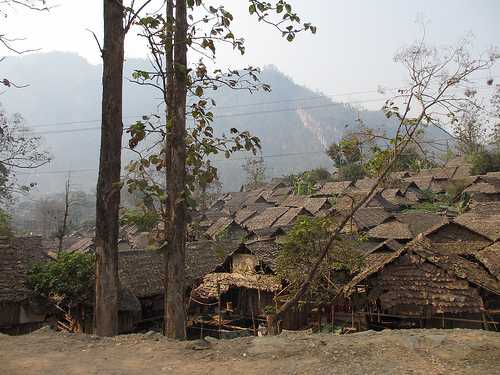 A small part of Mae La Camp
O is for oppression. The Karen have been fighting the world’s longest insurgency, which started against the Burmese Government in 1949. Oppression is too light a word for the government’s behaviour – their official strategy is called “four cuts” (cutting insurgents off from food, funds, intelligence and recruits). In practice this means burning villages to the ground and planting landmines to maim anyone who returns. The Burmese army has been perpetrating forced labour, rape, torture and killings of civilians for more than six decades now.
P is for perspective. Talking to people who have been through so much, and who have so little, certainly gives us some perspective. It’s embarrassing to think of what we happily complain about back home.
P is also for poverty. It’s most noticeable in the state of healthcare. One young girl hobbled off the truck that serves as the public bus at the hospital. Crying in agony, her legs were so swollen she could hardly walk. And people on the Thai side are the “lucky” ones – there are clinics and hospitals here, unlike in Karen State where healthcare often comes from a medic with a backpack.
Q is for qualifications. War and inadequate schooling has meant many of the students come to the college having had few opportunities to learn about the world. Some of the students will go on to other schools, but for others this will be the last formal education they receive. The vision of the college is to help develop leaders who can go back to Karen State and contribute to its future.
R is for respect for authority. And, like it or not, as teachers we are authority figures here. As a couple of casual, egalitarian kiwis we are taking a while to adjust to being waited upon. Everybody here goes out of their way to ensure that we are looked after.
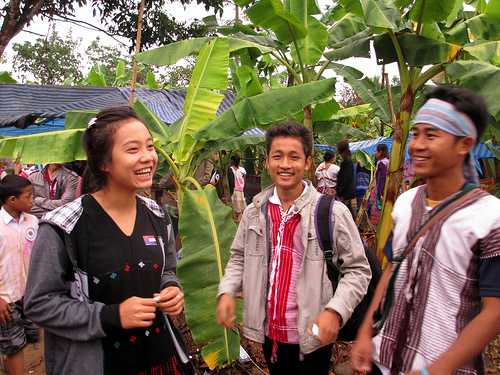
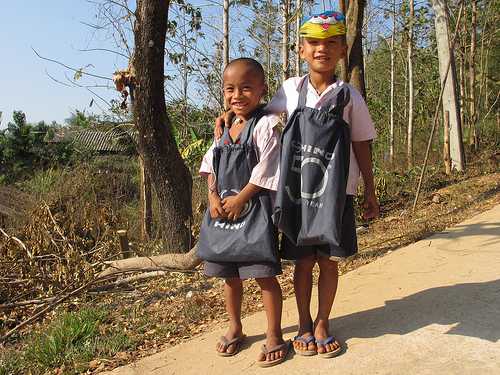
S is for smiles. The students have got the biggest, friendliest and most freely given smiles of anyone we’ve met. We are also treated to some great smiles from the young kids when we wander around the village, who call out “Good morning teachers” (no matter what time of day it is).
T is for toilets. The traditional Thai approach to bathroom design has taken some getting used to! The bathroom has two open concrete reservoirs – a small one holds water for flushing the toilet (with a scoop) and a large one holds water for bathing from. We have learnt to time our “showers” for mid-afternoon, as pouring cold water on yourself on a chilly morning or evening is less than ideal!
U is for unity. Around 15% of Karen are Christian, having been converted by missionaries in the 1800s. The remainder are a mix of Buddhist and Animist. In 1994, the Karen fractured between the Christian-led Karen National Union (KNU) and the Democratic Karen Buddhist Army (DKBA). The DKBA sided with the Burmese government and started fighting the KNU. That’s the simplified version, without going into the rest of the alphabet soup (BGF, KNLA, KNDO).
There has been a ceasefire in place for the past 12 months, the longest break in fighting since it began in the 60s. At all the public events we’ve attended, the need for unity between different Karen factions has been a key message.
Some here feel that the government has no desire for long-term peace, and that they are just consolidating and reinforcing for another offensive. If that is the case, the Karen people might have just a couple of years to strengthen their economy, infrastructure and military enough to dissuade a new assault.
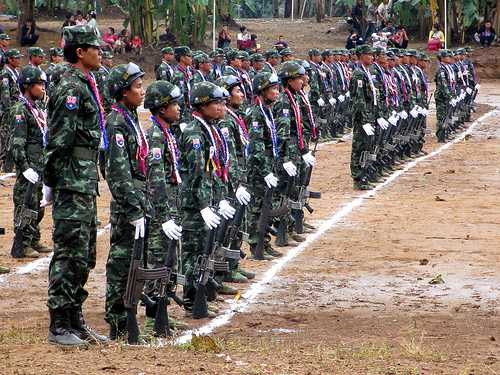 Karen soldiers on Karen Revolution Day
V is for voices. The students really enjoy singing, so we’ve had some fun evenings teaching them English songs. They’ve got some great songs in Karen too, which we’re hoping to learn while we’re here.
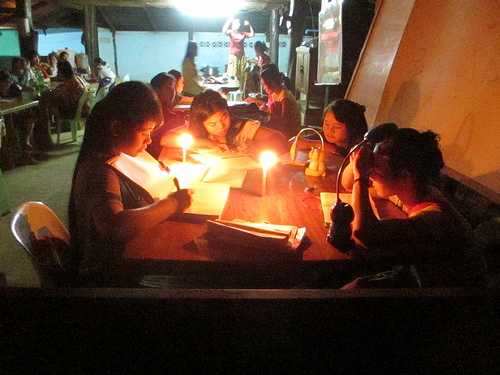
W is for working hard. The students study for an hour before class, then they have six hours of classes (English, computers, community health, Thai and maths), at least an hour of chores, then two hours of study time in the evenings. As for us, it’s important to us to do a good job for these students, so some days we’ve been working from 6:30 in the morning to 11 at night!
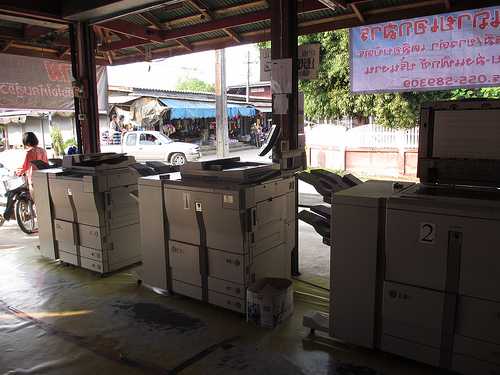
X is for Xerox. Internet + local copy shop = school resources!
Y is for yearning. The students here have a great desire to see democracy and respect for human rights come to Karen State. They often talk of how they plan to go back to their villages to help their people. Many of these students will be medics or teachers back in their village.
Z is for zest. The students passionately believe in the importance of education – both for themselves and their people. Many Karen never have a chance to get even a full primary education, so if a permanent peace comes to Karen State, these students will be among those starting the long process of development.
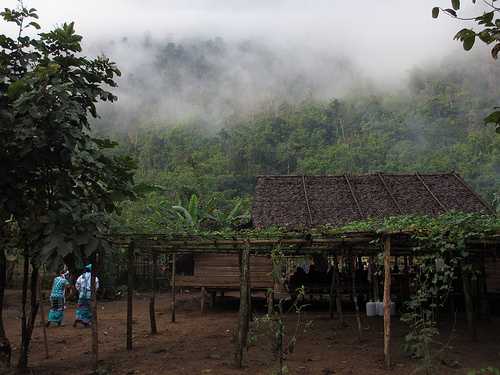
It’s hard to believe that we’ve already been at Kaw Tha Blay School for four weeks now. There are just three weeks of teaching left before exams and then graduation. We’ll try and find the time to do another update soon.
Comments from WordPress
-
Alice 2013-02-12T20:51:23Z
Wow, this is amazing! What an experience.
-
Tam 2013-02-13T07:44:58Z
Wow! Sounds like an amazing and rewarding experience. When you come back you’ll have to give me ESOL tips :) I found a list of useful activities, will email through to Sal incase some of it is useful.

Written by Craig Drayton and Sally Robertson