Craig and Sal Go Global
Trekking in the Himalayas
December 14, 2012
After a short taxi ride, we started our trek from the road end at Nayapul. Nayapul is a small place with taxis crowded along the edge of the road and vendors selling those last essential supplies. The two of us, along with our guide and porter, set off in the afternoon with just a couple of hours to walk on the first day. We were at the start of the Annapurna Base Camp (ABC) trek, a 10 day trek into the Annapurna Range of the Himalayas. Our trek begun with the very popular Poon Hill circuit before heading up a mountain valley to and from ABC.
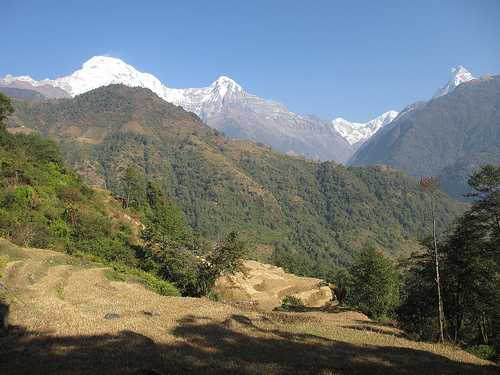
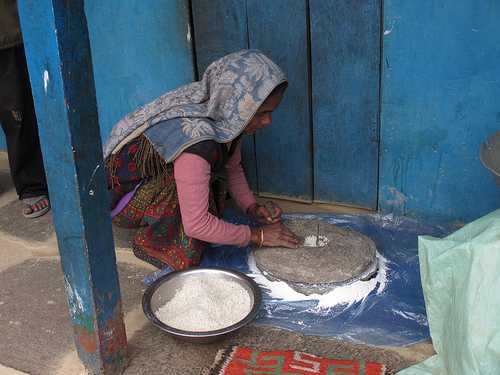
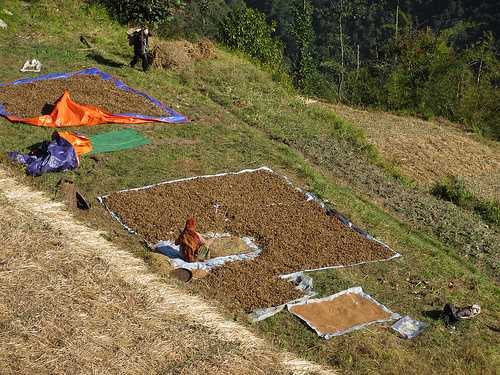
We started with a two day ascent to Poon Hill at 3,200m. During these first couple of days we passed through lots of small villages and terraces cut into hillsides for farming. The fields were full of crops of different colours – mustard, rice, wheat, corn, buckwheat and millet are all grown in the region. On all of the farms the work is largely done by hand, still using methods from hundreds of years ago. We saw farmers harvesting grain using sickles, threshing out wheat, using oxen drawn ploughs and making rice flour with a millstone. The houses here often have courtyards, which are important for processing crops. It was common to see people beating millet with sticks to separate out the grains and drying them on large tarpaulins.
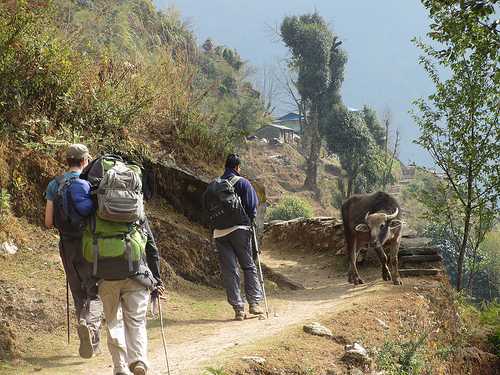
The trail was host to a whole range of working animals and livestock. We often had to move aside to let buffalo, horses, ponies, sheep and goats walk past. Sometimes a whole bunch of ponies would come past together, with big loads of goods or construction materials. They seemed a bit out of control, struggling to find their footing as they descended the slippery stone stairs (of which there were plenty).
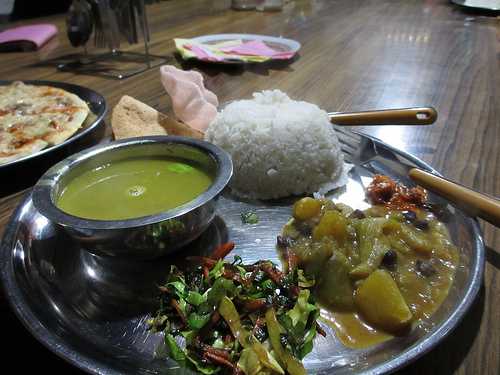
For the first few days we trekked with a couple from Holland. It was great having long games of 500 in the evenings once we reached the guesthouses. The guesthouses are basic but they are a lot more luxurious than the tramping huts back home. In each guesthouse we had a small room to ourselves, some offered hot showers and a few had a fire to sit around at night. They all offer a lot of choice in food and they seem to be about two hours apart, so you’re never far from somewhere to refuel. A lot of Western food is offered, such as pizza and macaroni cheese, but our favourite dish by far was Dal Bhat. Dal Bhat is a traditional Nepali dish consisting of a platter of rice, lentil soup, potato curry, poppadom and pickle. Most Nepalese people eat it for lunch and dinner every day without fail. Dal Bhat is all-you-can-eat, and we saw some of the porters putting away epic amounts after a hard day’s work.
Our porter was a tiny 44-year-old man who, until recently, was a poultry farmer. He didn’t speak much English but, from what we could gather, almost all of his chickens died suddenly from eating contaminated corn. He had no choice but to find work as a porter so he could save up enough money to buy more chickens and go back to farming.
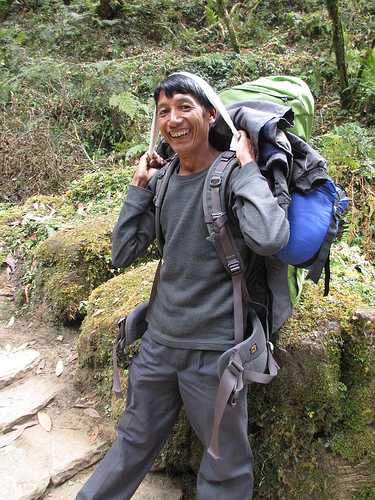
Each day our porter tied his small daypack onto our pack and then attached a headstrap which he used to bear some of the weight. We had put everything we needed for the trek in one pack, and left the other pack back in Pokhara. Even so, we struggled with having someone else carry our things for us (particularly someone half our size and twice our age). On the one hand, we were providing a much needed job, and this trek would go a long way to helping our porter return to farming. But we still couldn’t help but feel guilty at how spoiled we are in comparison and how hard he has to work for so little.
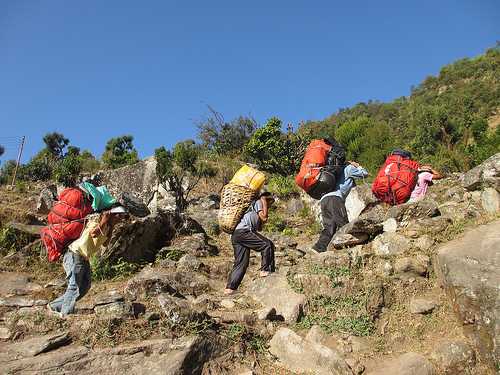
Porters are supposed to carry a maximum of 25kg, but we were told that this is often ignored, with some carrying up to 50kg. We saw many porters with huge loads, some with five packs strapped together. The porters were often wearing light and basic clothes (even jandals). From what we can gather, most porters do all of this for around NZ$18 per day (although some get paid even less). We tried to look after our porter as much as possible, and were really happy when he said to us on the last day “You have been very kindly to me”.
On our third day, we rose early from our guesthouse at Ghoripani to climb Poon Hill before sunrise. It was very cold at 5:00am, so we started off wearing so many layers that we looked like marshmallows! The walk up reminded us an awful lot of walking up to Machu Picchu – being in the dark with a long queue of people wearing headtorches, shuffling slowly up the stairs. It had been pretty busy on the trail on the previous days, but now it really was like standing in a line.
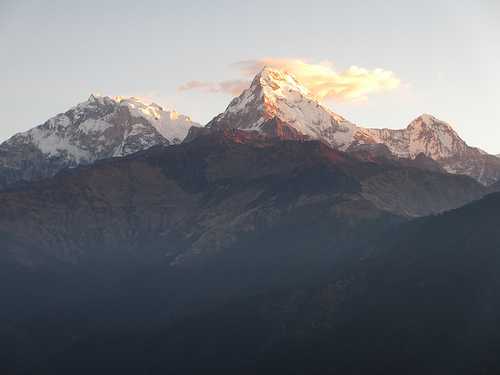
We reached the top of Poon Hill, at 3,200m, just before sunrise. As the sky lightened, we got an awesome panoramic view of the Annapurna mountains. The highest of the Annapurnas is the 7th highest mountain in the world and we could see three peaks of over 8,000m.
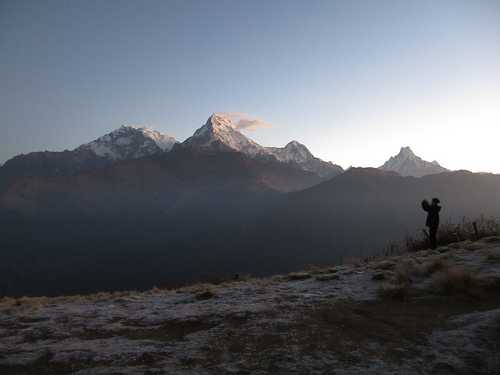
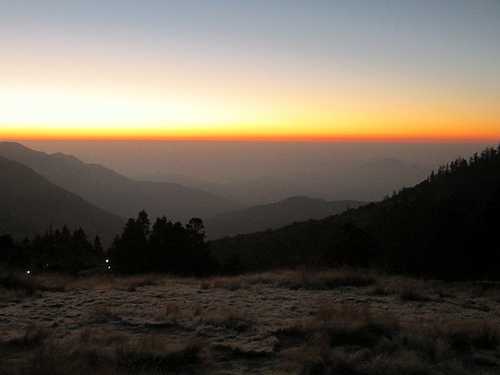
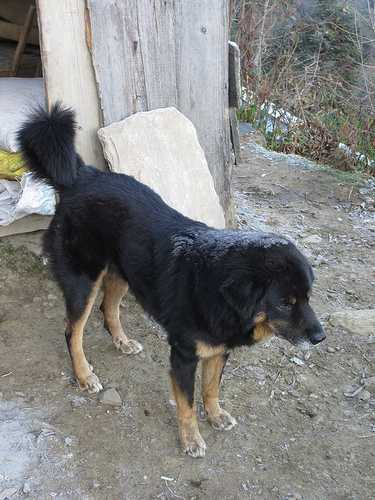
While at the top, Craig started feeling dizzy and had to sit down. We were above the height where altitude sickness can occur, so this wasn’t a good sign for the rest of our trek (when we would go above 4,000m). Hoping that it was mostly the early exercise and lack of food, we headed back down to the guesthouse for breakfast. Now that there was light, we could see that everything was covered in a heavy frost – even the dog.
The next couple of days took us to the junction of the Poon Hill circuit and the ABC trail. We were glad we were going to both Poon Hill and ABC, as we were told that they were quite different experiences. The view from Poon Hill was beautiful, but the mountains still felt quite distant. The ABC trail would take us up a mountain valley to the base camp at 4,130m, nestled amongst several of the huge peaks.
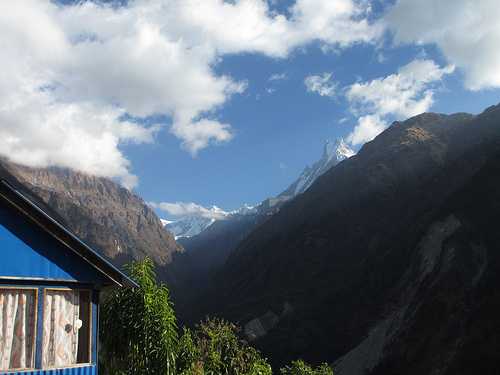
The scenery was different on this section of the walk, with fewer villages and more forest. One evening we noticed dark shapes flying right past us on the guesthouse balcony. We realised that they were bats, and spent a while watching dozens of them fly past. Sometimes it would seem like they were about to hit us, until they veered away at the last second.
One day we stopped for a break at a guesthouse where a young girl, maybe one year old, was playing by herself. After checking with her mother, we got out some bubble mixture that we had bought especially for the trek and started blowing bubbles with her. She was really cute and we played together for a while. But it turns out we hadn’t thought through our exit strategy. As soon as we got up to leave, the girl burst into tears and her grandmother had to stop working to try to soothe her. Feeling very awkward, we left the village behind having turned a perfectly happy child into a crying one.
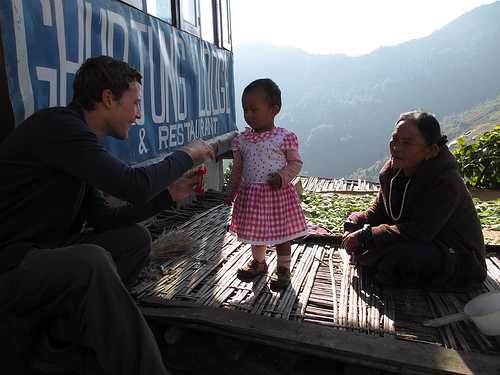 The good times
We had chosen to bring bubble mixture because we didn’t want to bring toys or candy – things that cause rubbish and encourage begging. But when we thought about it later, we realised that the whole idea of bringing something for the kids was really more for our benefit than theirs. The kids can happily entertain themselves without needing foreign tourists to show them things they can’t have.
Leaving the kids with presents is perhaps even worse. Several times children would say “Namaste! Chocolate? Candy?” as we walked past. The saddest case was an infant who couldn’t yet speak, but who crawled towards us with his hand out.
We took three days to walk the return trail to ABC. The scenery changed again – we were now walking up a mountain valley beside an icy glacial river. As we got higher, we saw spectacular frozen waterfalls and streams on the sides of the valley. There was a heavy frost everywhere and even some snow around. Thankfully, Craig had no problem with the altitude as we climbed. The clouds rolled in one afternoon, creating a cool ghostly atmosphere.
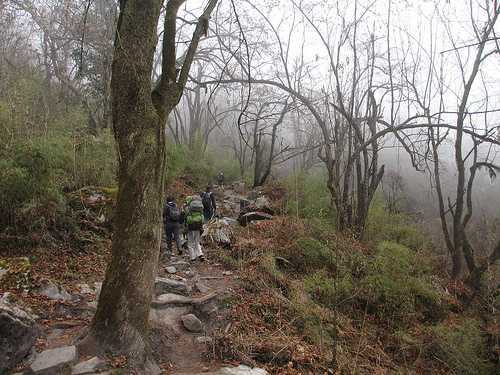
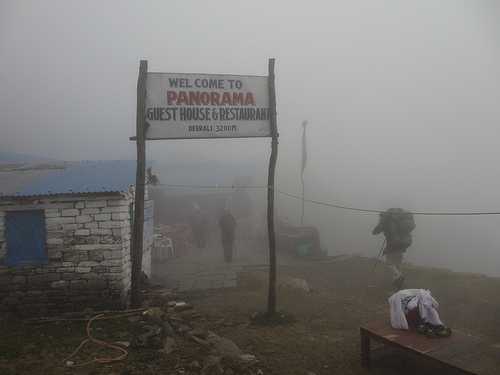
The guesthouses are uninsulated and unheated, so night times at high altitude are very cold at this time of year. As the nights plunged below freezing we even took to wearing down jackets in our sleeping bags overnight.
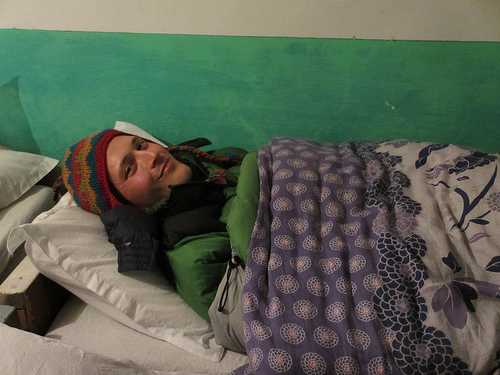
One evening in a busy guesthouse dining room, a loud hissing noise was quickly followed by a Nepali man walking into the room with a huge flaming kerosene burner. The heavy fabric tablecloth was lifted up and the burner went in amongst our feet. This would surely fail an OSH inspection back home, but we were grateful for the warmth.
To avoid sleeping at the highest and coldest guesthouses we rose early one day to climb to ABC. Each day clouds had been rolling in mid-morning, so we planned to see the view early and then head back down to stay the night somewhere warmer.
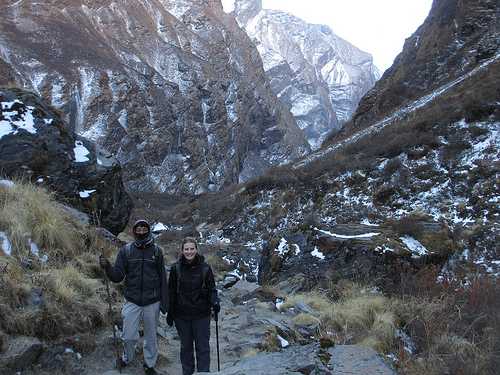
We approached ABC just as the sun rose over Macchapucchre, a gorgeous sight. The shadow of the mountain retreated slowly down the valley – we could even walk along and see the sunrise all over again.
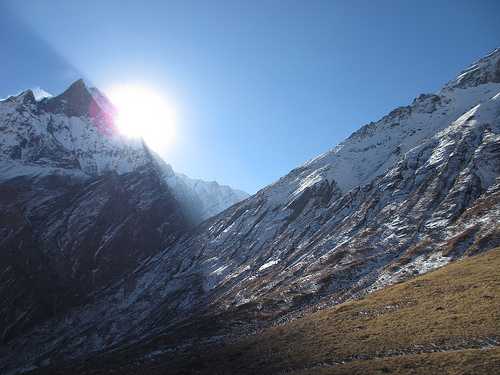
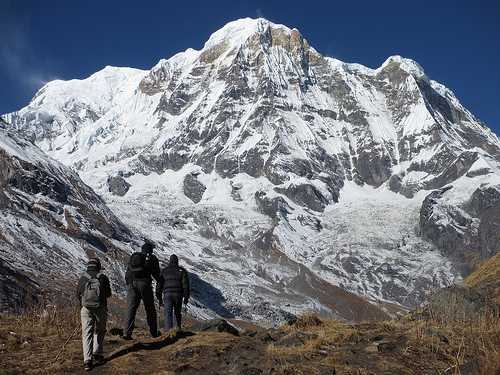
We got to the top and enjoyed a cup of tea while looking around at the spectacular mountains surrounding us. Even though we had walked to 4,130m (higher than Mount Cook), the mountains above us were still impressively tall – we were at just half the height of the tallest peaks.
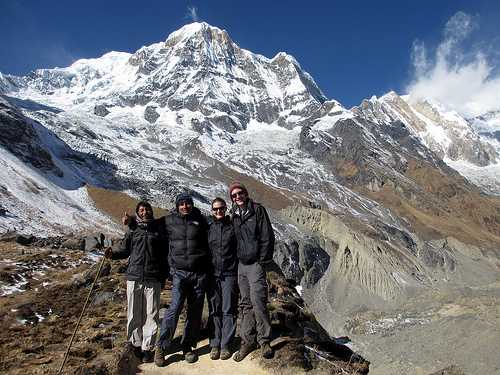
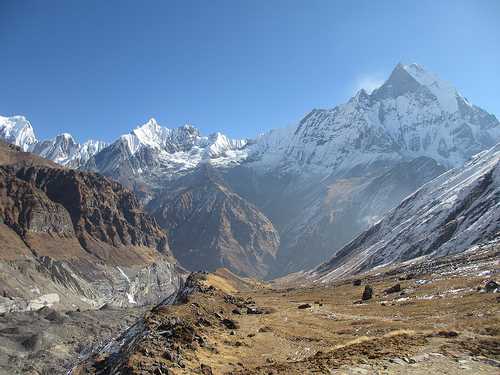
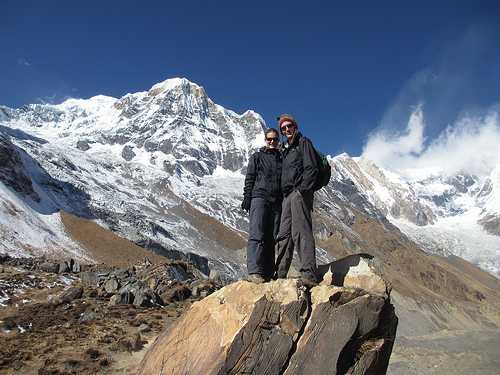
The walk down was quick - we got all the way back down to Bamboo, at 2,335m altitude, before stopping for the day. This was the first day that was as long and hard as what we’d expect from a day’s tramping back home – a combined climb and descent of 2,700 vertical metres!
After Bamboo, we realised that we didn’t really need as long as we had in our itinerary to walk out. Up to this point we were already feeling well rested, with each day’s walk only taking around six hours (including a long lunch break). We were facing some ridiculously short days, so we arranged with our guide to take a detour and also finish a day early.
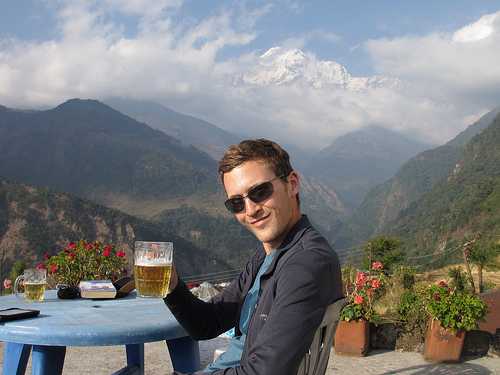
Our trek in the Himalayas is right up there as one of the best experiences of our trip. We hope that we will be able to come back to Nepal someday for some more trekking. Almost all tourists who go trekking in Nepal go to just five or six famous trails, including the ABC trek. We think it would be exciting to one day plan a trip into the mountains in a less explored region of Nepal.
The end of our trek returned us to Pokhara, a large city in the foothills of the Himalayas. There’s a vibrant tourist centre here catering to trekkers, but it’s a lot more pleasant and quiet than chaotic Thamel. It’s the perfect place to relax, rest and get a few things done. First job: adjust back from the 8pm bedtime of the mountains!
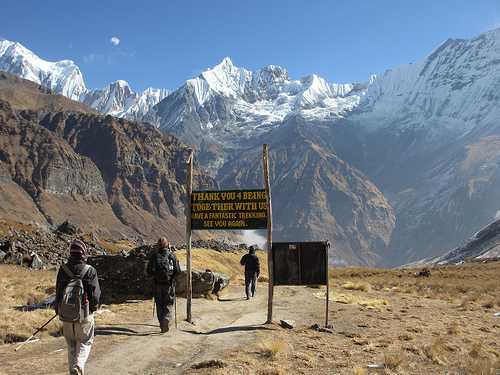
Comments from WordPress
-
Alice 2013-01-02T23:38:09Z
That looks so incredible. Fitness level required???
-
Craig and Sal 2013-01-05T03:39:59Z
Hey Alice, Happy New Year!
All sorts of people were managing to do the trek. With teahouses every couple of hours at most, you can go as fast or as slow as you like. Having your bag carried also makes it a lot easier.
A lot of the uphill is on steep stone stairs, so if you can climb these steadily without tiring it’s a faster and more enjoyable walk. If you want to know any more info, get in touch and we can easily tell you more :-)

Written by Craig Drayton and Sally Robertson