Craig and Sal Go Global
Taking the waters of Bath
August 18, 2012
A few centuries ago, the wealthy elite of England flocked to Bath to “take the waters” of the town’s natural hot spring. If it was good enough for them, it’s good enough for us – we spent a couple of days exploring the city and its ancient baths.
When the Romans conquered Britain they were excited to find a natural hot spring in England. Believing this to be a miracle, they built a huge series of baths along with a temple complex devoted to the goddess Sulis Minerva. The ruins of the baths were discovered in the 18th century and the site has been partially reconstructed since, so that visitors can get a sense of the original buildings. We visited in the evening when the baths are lit up with flaming torches – very cool.
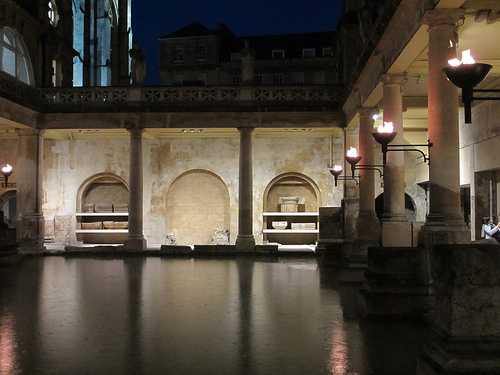
An audio tour was included in the admission fee. We found it excellent – it covered a range of social, historical, architectural and technological information and had supplementary commentary by Bill Bryson. We found the audio tour so engaging that we spent a lot longer than expected there and ended up being the last people out that night!
The first thing we noticed about the baths is that they appear to be in a deep pit. Apparently modern ground level is five metres higher than in Roman times – each new civilisation has built on top of the old one! Here is the view down into the baths:
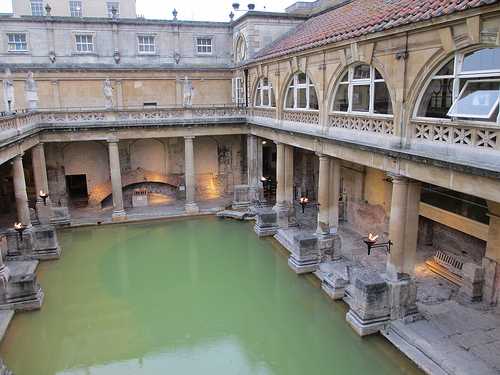
The level of technology the ancient Romans enjoyed is amazing. Lead piping took water from the spring to a large series of pools providing a range of different temperatures. There was under floor heating in a set of sauna rooms. We also saw how Romans used double-pulleys and clever anchors set into stone blocks to construct the buildings.
You can’t bathe in the historic baths any more but some modern baths opened recently. The construction of these was set back when the builders accidentally used non-waterproof paint, flooding the building with paint-laden water. Sounds like they were better at this sort of thing a few thousand years back!
The baths meant much more to the Romans than just a place to wash. They were considered a place of healing, with special baths just for the sick. They were also a place to socialise and conduct business. Interesting considering that both sexes bathed together and in the nude (it’s business time – Roman style). The baths provide an insight into Roman norms. The site was a holy religious temple – nowadays we wouldn’t think this to be compatible with mixed nude bathing! Social class was important in the baths, as elsewhere in Roman society. The elite bathed first thing in the day before the water was dirtied (both figuratively and literally) by the common people.
Wealthy Romans could bring along slaves to guard their clothes, but theft was a possibility for other bathers. Luckily the baths had recourse for those wronged – it was common practice to write “curses” on pieces of lead and throw them into the sacred spring, so that Sulis Minerva would enact revenge. People wrote as much information as they could on the lead regarding the identity of the perpetrator (sometimes this included a list of suspects), along with a requested punishment. The punishment often seemed wildly out of proportion to the crime – “they should be put to death and dragged through the streets for the theft of my toga”.
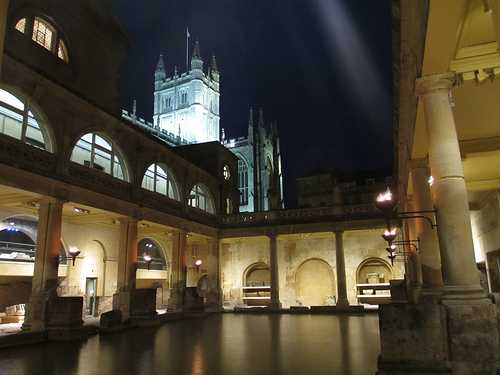
Jumping forward in time, the baths became popular again with the following a visit by Queen Anne. Once here, the wealthy had an extensive social calendar imposed by the town’s Master of Ceremonies. This included bathing, drinking spring waters, dancing and “promenading” (walking around the neighbourhood in all your finery). This schedule ran from early morning to late at night and repeated every day. Being on a hill, the wealthy decided they didn’t want to have to walk home after their long day, so they had a special gravel path constructed where they could be carried up and down in litters by sedan chairmen.
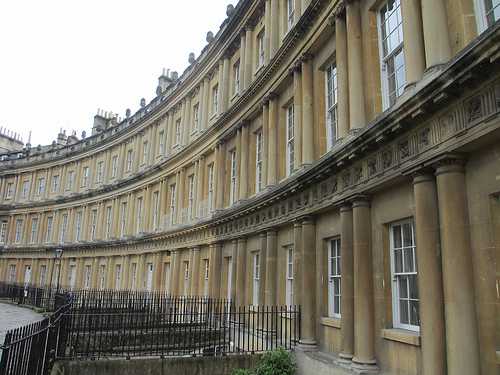
The stone wall in this photo is called a haha - a sunken fence similar to a retaining wall. The land on the left used to be used for grazing, so the haha would keep the livestock off the lawn without blocking the residents view! Pretty cool.
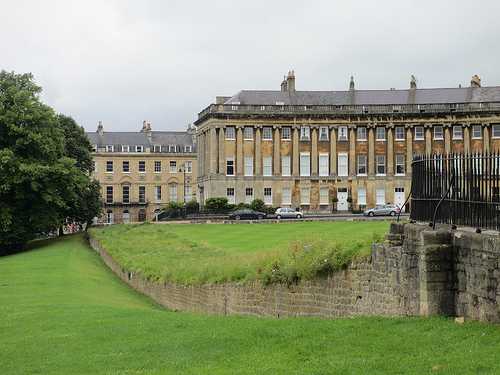
Of course our experience was somewhat less decadent. We didn’t bathe (it’s 26 pounds!) and instead of living in a large townhouse on the Royal Crescent we stayed at… the Bath YMCA. It was, we decided, the worst hostel we’ve been in yet. The atmosphere can best be described as homeless shelter – the guests seemed to be about half travellers and half homeless people. There was a strange smell in the corridor for the whole stay, which was only upstaged by the large smear of excrement Sally found on the floor of the women’s’ bathroom. To add insult to injury, this was one of our most expensive hostels!
Apart from the hostel, our experience in Bath was really enjoyable. The residents are obviously very proud of their town, and rightly so. The town has a unity about it, with almost all of the buildings fitting into a similar aesthetic of Bath sandstone. Leaving Bath, we boarded a train heading north to the old medieval town of York.
Comments from WordPress
-
Richard Harker 2012-08-19T11:13:07Z
Ah, great reminders of my travels there in 2006! Can’t wait to hear about York - I absolutely loved it. Is a “haha” so named to reflect the cry of the unsuspecting garden wanderer coming across the sudden drop in front of him? I can just imagine it :)
-
Frederieka 2012-08-20T09:14:20Z
Apparently Jane Austen hated Bath.
Wikipedia says ‘Usual etymology is that an expression of surprise – “ha ha” or “ah! ah!” is exclaimed on encountering such a boundary.’ which is a pretty strange way of naming something, really.
and Terry Pratchett uses hahas in one of his Ankh-Morpork books - I think they’re in the Patrician’s gardens.
-
Hay 2012-09-09T03:09:48Z
The history/background you are putting into the blogs is great - really adds some flavour to your experience! I’ve never been to Bath - will have to put it on my list for next time :)

Written by Craig Drayton and Sally Robertson