Craig and Sal Go Global
The favela communities of Rio de Janeiro
June 22, 2012
Driving up the hill on a windy road, we passed an idle police car by the side of the road. We had reached Rocinha. Just by passing through the intersection, we went from a neighbourhood with a standard-of-living equivalent to Canada to one equivalent to Ghana.
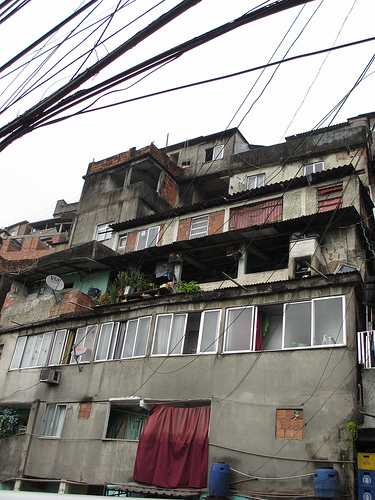
We were on a favela tour in Rio de Janeiro, which took us to visit two of the city’s favelas. Most people associate favelas with crime, drugs and poverty alone. However, our guide Patricia emphasised the sense of community that permeates the favelas – a necessity when so many people are living together in such close proximity.
There is debate around the ethics of “slum tourism”. Critics see tours like the one we took as exploitative, voyeuristic and self-serving. Proponents believe they can break down stereotypes and provide income to the community. While ideally we would have visited favela communities in a more genuine way, this isn’t necessarily safe (particularly with our lack of local knowledge and Portuguese language). On balance we felt that it was better to see the communities for ourselves in a tour than ignore them. There were times on the tour we did feel uncomfortable about being “slum tourists”. However, we felt the tour was conducted sensitively, emphasising the positive aspects of the communities (sometimes even a bit too much). We also made a small economic contribution to the communities by buying things from local vendors and because 40% of the tour fee is donated to a local school.
Favela communities began as settlements of freed African slaves. The communities grew rapidly in the 1970s, as the rural poor of Brazil moved to the cities in search of a better life. Unable to afford legitimate land ownership, the migrants cleared vacant or forested land in the cities and erected their own dwellings. In most cities the favelas develop at the fringes of the city. The favelas in Rio de Janeiro are unusual because they are interspersed throughout the city. This is because of Rio’s hilly topography which leaves pockets of undeveloped land. There are over 1000 favela communities in Rio, making up around 20% of the city’s population.
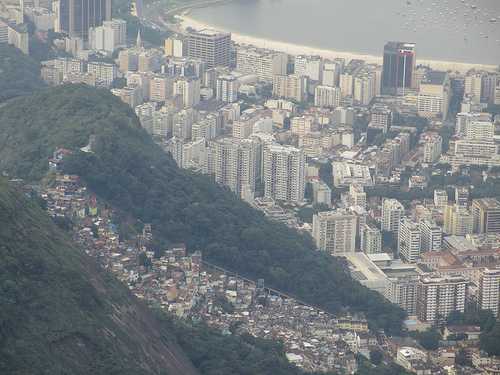
Patricia told us about how there is a strong work ethic in Rio de Janeiro. For a large city with a sizable poor community, there is not much begging. Instead, everyone is expected to find a job – even if just washing car windows or collecting aluminium cans for recycling. We noticed here a lot more low-skilled jobs that you wouldn’t see in New Zealand (such as lift operators, bathroom attendants and couriers using large hand-drawn carts for deliveries). The working-class of Rio de Janeiro often live in favela communities, coming down to the “asphalt city” to work.
Many of the city’s construction workers live in favela communities. This is important to the development of the communities – as residents do not hold title to the land they either build their own homes or have the help of a skilled neighbour. Patricia explained how the houses are designed stronger than necessary so that the owners can then sell the space on their roof for another house to be built upon. Most of the houses we saw had three or four stories – each belonging to a different family. It is usual to have children young and to have large families, so there are often households of 7-8 people in a house the size of a studio apartment.
We saw two favelas on our tour. Rocinha (pronounced hoe-seen-ya) is the largest favela community in Brazil. It has around 70,000 residents according to the census, but is widely thought to house several times this number. Vila Canoes is a much smaller community, with around 2500 residents.
The main street of Rocinha is an old Formula One racing track – barely two lanes wide and yet it teems with trucks, motorcycles and busses (there are four bus lines through Rocinha). After a stop at a small market of local artists we are shown through a garage to a terrace with a great view over the community.
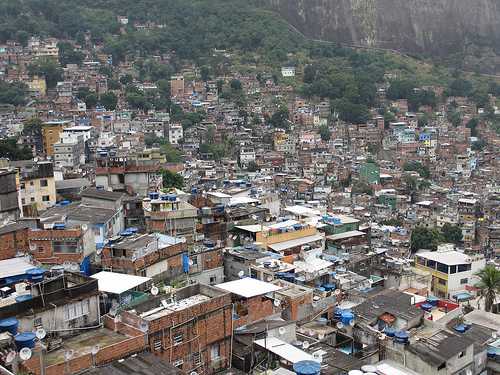
Our guide explained the construction of red brick. The solid masonry means that the government cannot easily tear the houses down. The similarity of houses makes it hard for the police to distinguish between them, therefore effectively hiding criminals. The relationship between the communities and the government/police is complex and changing. Several times throughout the 20th century the Brazilian Government has evicted residents from favelas and forcibly relocated them. The police here, though improving, have a legacy of corruption and brutality.
Since 2008, the Brazilian Government began a program of favela “pacification”. This is where a combined military and police force enters a favela and takes it over from the reigning drug lord (sometimes in a firefight).
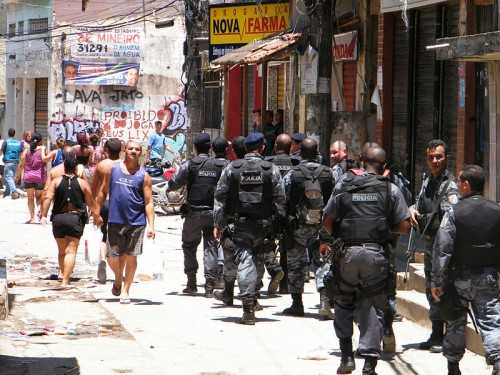 Police occupy Complexo do Alemão. Photo by Agência Brasil (via Wikimedia Commons)
Once the drug lords are arrested, dead or expelled, a community policing unit is put in place to try to sustain the government’s control of the area. We had a simplistic view that government control would surely be an improvement on living under the rule of drug lords. But the reality is more complicated. For one, civil officials follow shortly after the police, disconnecting the residents’ illegal cable TV. Wiring in the communities is intentionally tangled and confusing to make it hard for the government to disconnect.
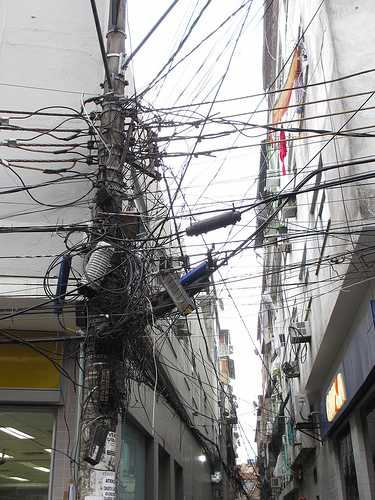
The drug lords, while violent, often provide protection and support to the community (in exchange for their loyalty). We heard that there is little crime within a community controlled by a drug lord, as they do not allow it, issuing severe physical punishments for those who disobey. Given the residents’ distrust of police, it is easy to see how some feel less safe under the new regime. However, pacified communities do see improved public services (such as rubbish collection) and can have their children grow up without seeing gun-toting criminals running their community.
Rocinha has only recently been pacified, in November 2011. The special policing unit will now stay in Rocinha for 25 years, or perhaps longer. We walked along the main commercial street. We were surprised to find that it felt safe, vibrant and welcoming. In fact, we felt more comfortable here than we have in many other places we have visited so far. Traffic moved slowly around the many pedestrians and shops and vendors lined the street. It felt reminiscent of a market street in Asia.
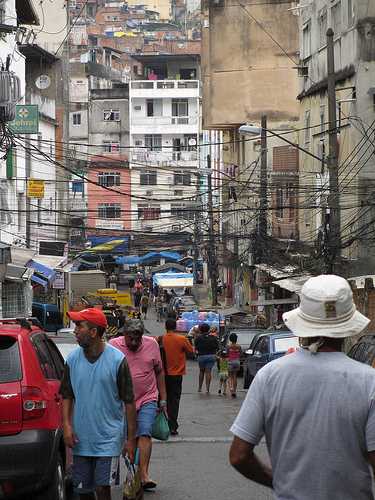
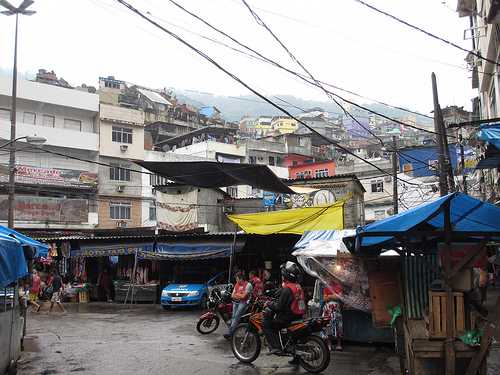
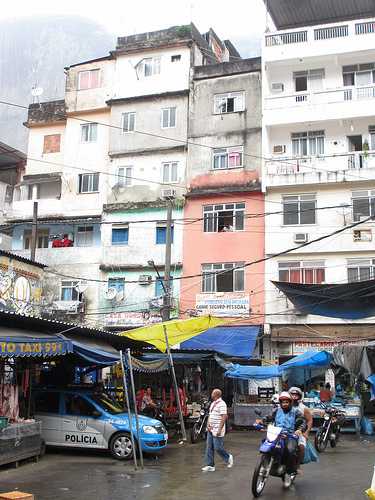 Another thing that struck us was the quality of the food on sale. The fruit looked much better than what we have found in a typical Chilean, Argentinian or Brazilian supermarket. Among the stores were a greengrocer, a fishmonger and a butcher. According to Patricia, residents here are very fussy about the quality of their food – for them a good life means having good food, good sex and a plasma TV to watch the football!
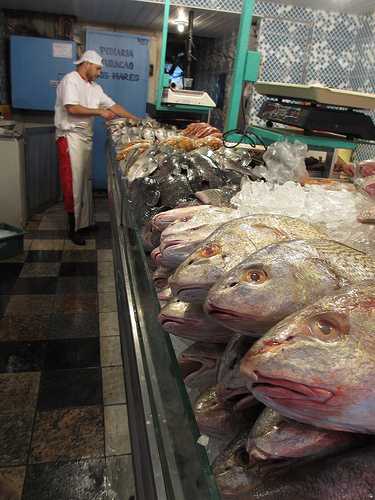
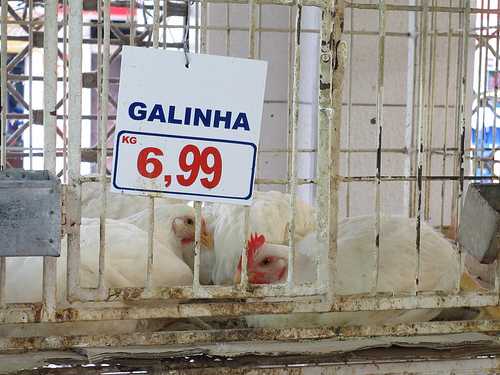 Some of the food was extra fresh!
Patricia explained that they could still not be sure of our safety in the smaller streets and alleys of Rocinha, so we drove to Vila Canoas. As well as being small, Vila Canoas is situated in a valley. This means it is not suitable for a fortress, as the police could fire down from the valley walls, so it has never been a site for drug manufacture and trafficking.
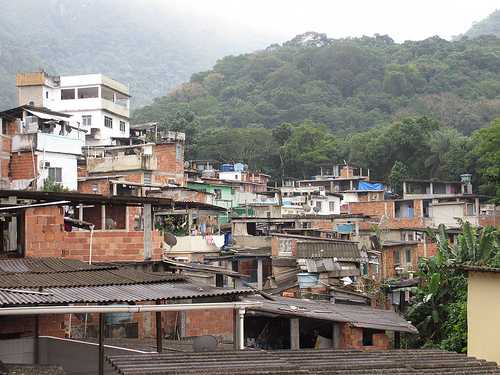
We took a walk through Vila Canoas and were able to get closer to people’s homes. Up close, the quality of life issues become more apparent. The houses and alleys feel cold, damp and cramped. They are built together so tightly that light hardly reaches the ground in places. In most alleys we had to walk in single file, and the access to some homes looked treacherous.
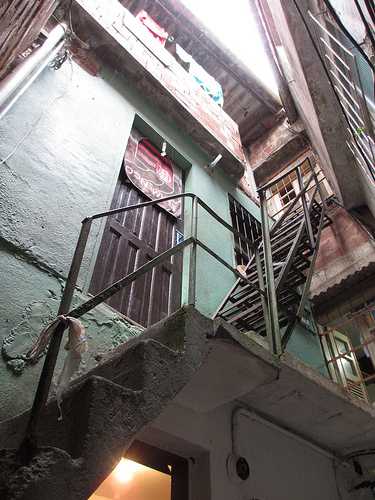
These living conditions mean that tuberculosis is a major health issue in the communities and we saw a number of health clinics offering vaccines. While most residents have power and water to their homes, fewer have access to good sanitation – another cause of infectious disease.
We are very aware that we had just a small glimpse into life in favela communities. We of course do not claim to know what life is like for the residents. We also know that the two communities we visited are relatively safe and well-developed. Each community will be different and we really enjoyed the opportunity to see these two, even if just for a short while. We came away with a deeper understanding of favela communities – as places where real people live their lives.
Comments from WordPress
-
Garry 2012-06-23T00:46:17Z
A great set of photos and commentary … I enjoyed reading it. Yes, you do have to wonder about the “slum tourism” thing, don’t you, and how the residents of these areas feel about busloads of tourists coming through and observing their lives?
So, you’re zipping back across the continent to Peru - today? It’s hard to believe you’ve been away less than month considering the amount of ground you’ve covered and the experiences you’ve packed in so far!
Good travels!
-
Rio de Janeiro | Craig and Sal Go Global 2012-06-25T01:33:36Z
[…] P.S.: We went on a Favela tour while we were in Rio, which you can read about here. […]
-
Beth Braddock 2012-06-25T23:25:11Z
Yes, one struggles to know whether providing legitimate income at the expense of people’s privacy is conscionable! Still, the dilemmas of travelling, like this, are often what stay with you later! A great account Craig & Sal: and thanks for mosaic photos — keep them up, for me!
Go well Beth
-
Gary 2012-07-03T09:00:23Z
great post Craig

Written by Craig Drayton and Sally Robertson